Varda and United Semiconductors Announce Joint Development Agreement
The future of the orbital economy relies on a diversity of platforms supporting foundational research.
Varda Space Industries and United Semiconductors are pleased to announce a multi-flight joint development agreement to produce semiconductors in orbit for use on Earth.
- Varda designs and builds autonomous reentry-capable satellites for material processing in microgravity. At Varda, we primarily use our W-Series reentry vehicles for our own pharmaceutical development, but due to their cadence and cost-efficiency, we are also able to accommodate payloads for a variety of uses and customers.
- This partnership heralds the first example of a partnership between Varda and a company that has flown NASA-funded experiments on the International Space Station.
- Varda has successfully completed three missions, and the fourth, W-4, is currently in orbit. A fifth mission will launch in the coming weeks and four more are expected to launch and return in 2026.
Through its work on the International Space Station and in its terrestrial semiconductor substrate foundry, United Semiconductors has developed a process for commercial orbital manufacturing of crystals for high throughput production of semiconductor materials for use in next generation autonomous systems, sensing, artificial intelligence, aerospace, and defense components.
"Varda’s W series vehicle is the missing link for material development and production in low Earth orbit."
— Eric Lasker, Varda Space Industries CRO
“Autonomous infrastructure is needed to rapidly experiment and develop next-generation products made in space,” said Dr. Partha Dutta, Chief Technologist of United Semiconductors LLC (USLLC). “We’re thrilled to partner with Varda, the only company today with a free flyer that can rapidly scale in-space production through increasingly routine reentry cadence.”
Producing these materials in microgravity improves the quality, yield and reliability of the semiconductor devices, resulting in performance improvements that are impossible to achieve with terrestrial manufacturing.
As the ISS ages and commercial space stations slowly come online, the U.S. is entering a transitional period in orbital infrastructure. Orbital research and production will be most efficient when a diversity of platforms—including autonomous vehicles—are enabled.
“A sustainable, productive future in space demands that we stop viewing crewed and uncrewed missions as rivals. Instead, we must recognize them as partners—a two-pronged strategy for maximizing impact and unlocking the full potential of the LEO economy,” wrote Francisco Cordova, COO of the ISSNL in a recent blog post. “The road beyond the ISS isn’t a fork. It’s a runway, and we need every kind of engine to launch what comes next”
Varda’s capsules offer capabilities for rapid iteration, testing, and production beyond human stations, and can scale infinitely and quickly by flying more frequently. They also provide greater operational flexibility and easily handle toxic chemicals and high-temperature materials processing all while being more economical for tasks where human intervention isn’t explicitly required.
“Varda’s W series vehicle is the missing link for material development and production in low Earth orbit. We’re thrilled that United Semiconductors is able to take advantage of our vehicle to move beyond the world of one of experimentation and towards economically viable scaled production,” said Varda Chief Revenue Officer Eric Lasker.
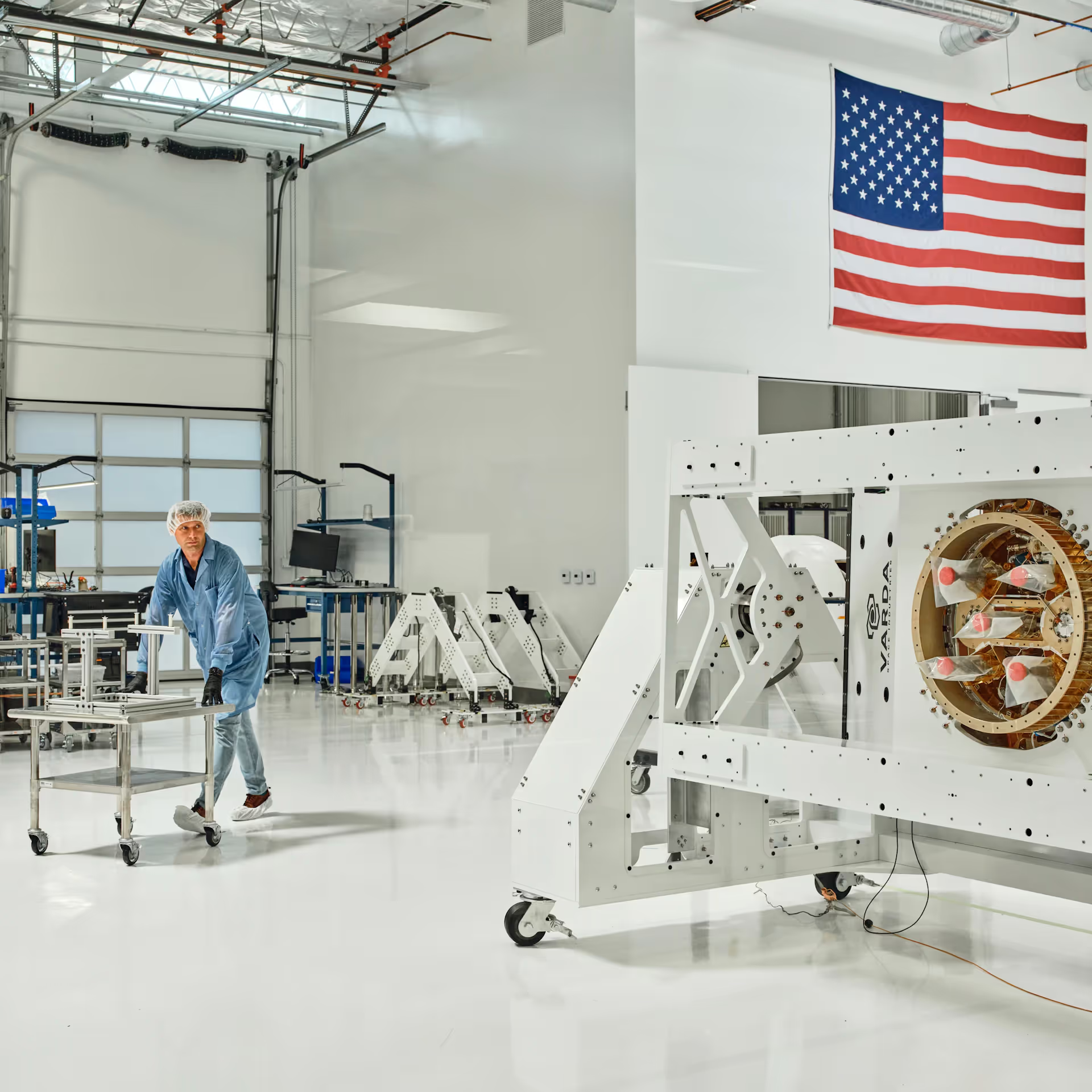
Photo: Varda's El Segundo headquarters, where all the W-Series vehicles are produced. Photo by Philip Cheung, New York Times